
Натиснете ТУК за българската версия на този материал
- AI is a greater transformation than the PC and internet revolutions, but value is created only when it is integrated into the business, not as a side experiment. Data is the "oxygen" of AI, and the biggest barrier is human mindset, not technology.
- Ingram Micro has built an AI-powered digital platform called Xvantage™, through centralized data, its own AI factory, and model independence. Through the platform"s continued innovation, including its Intelligent Digital Assistant (IDA), Ingram Micro is generating hundreds of millions of dollars and driving corporate revenue growth through distributed intelligence.
- The future lies in collaboration between humans and AI agents, where employees redefine their roles, learn new skills, and manage intelligent agents, while companies focus on value and growth rather than routine operations.
- Bulgaria is a strategic technology hub for Ingram Micro because the local team demonstrates quick adaptability, curiosity, and the right mindset - the most valuable asset in the era of artificial intelligence. The Sofia office is becoming key to the creation of AI processes and agents.
Sanjib Sahoo is a business leader recognized globally for his role in modernizing three long-standing industries, including the global B2B technology distribution ecosystem. Sahoo has been honored as a Global Technology Icon and is nicknamed "digiGOAT" by CIO News. In 2023 and 2024, he was among the top five "disruptors" on the CRN Top 25 Disrupters list and is a recipient of the Dr. APJ Abdul Kalam Award. That same year, he was also included in Fortune"s "Unstoppables" list alongside names such as Elon Musk.
As Executive Vice President and President of the Global Platform Group at Ingram Micro, he leads the global platform strategy for the Fortune 100 company, including the development of the AI-driven digital platform Xvantage.
When it comes to technological transformation, Ingram Micro has been through a lot - it is a well-established company. This certainly gives you the ability to adequately assess processes and gauge the potential of a given technology to drastically change the way business operates. What is the case with artificial intelligence? Will it prove to be a force for change in the same way that the personal computer and the internet were?
I believe this is something bigger than the PC revolution and the internet revolution. And I"ll explain why.
We shouldn"t view artificial intelligence as a technology that, on its own, drives radical change. Many companies try to "do AI," creating models and only then looking for a business problem to solve. That doesn"t create real value.
In most organizations, AI is a side project, while the core business continues as usual. The real challenge is how to integrate artificial intelligence into the business itself. Many clients are working on improving their processes, but also on their day-to-day operations. AI must be applied at both levels.
This raises the question of how you work with data - it is the foundation of AI. Data is oxygen. Without data, there is no artificial intelligence.
How do you foster a mindset for change? AI isn"t perfect. It teaches us to be "imperfectly perfect" - to get a little better every day. That means focusing not on the 40% chance of failure, but on the 60% chance of success.

Another key point is how to integrate business processes and artificial intelligence so that they create value. Less than 1% of companies actually achieve value with AI.
You need to start with the business problem and understand the capabilities and maturity of your AI. Is your data mature? Are the systems centralized? Can they communicate with each other? Are the processes mature and streamlined? Do you have an architecture independent of a specific model? If all of this is in place, take a specific use case, solve the problem - and repeat.
The biggest barriers to AI implementation are not technological, but human. People are afraid: "Will it take our jobs? Will it replace us?"
We shouldn"t fear AI; we should embrace it. Because it is precisely the willingness to learn new things that makes the difference. AI will not replace people, but rather those who refuse to learn how to work with it.
View AI as a tool for growth. As a tool for optimizing the back office. Tie it to specific metrics: does it increase revenue? Does it improve margins? Does it reduce costs? That is the right approach.
And speaking of that - all the challenges and the shared need to work hard every day to reap the benefits of AI implementation - what were the biggest challenges you faced?
We started this journey four years ago when I joined the company. We decided we wanted to be a company with an intelligent platform. The first challenge was the massive decentralization—processes across dozens of countries.
So we started with the data. First, I hired a Chief Data Officer from Facebook and Instagram. We began building a single source of truth and a real-time data mesh architecture - a massive challenge.
Then we created our own AI factory, where we test our models and became independent of specific models. Today we have over 400 proprietary AI and ML models.

Източник: Ingram Micro
Next, we built the platform on top of the transactional data mesh network - another major challenge.
We attracted a lot of technical talent from companies in Silicon Valley. In just three years, we wrote over 42 million lines of code and have over 36 patents pending.
Today, we have a network of over four petabytes of data powering 400 models. We are model-agnostic.
From deep learning and machine learning to agent-based AI and proprietary models - we"ve created an AI-driven experience.
We saw a 14% year-over-year revenue growth, with AI being one of the key drivers. We"re creating value, but challenges remain: process centralization, data centralization, security, and integration.
And most importantly - the shift in mindset. For a company with over $50 billion in revenue, 45 years of history, and a presence in 57 countries, this is the hardest part. Managing mindsets is the biggest challenge facing AI.
And as you"ve already pointed out, artificial intelligence is perhaps less of a technical issue and more of a human one, with all the corresponding problems that stem from that. In any large company, the dynamics are very similar - being efficient, being modern, but also being a comfortable place to work for employees, and so on. How do you strike a balance?
There"s no easy answer. There are two types of employees: some are curious and teach themselves; others wait to see what will happen and are wary of the new.
We often view AI as a replacement, and that breeds fear. But if you create an environment where AI is used to rethink work - so that people can grow and become better - the reaction is different.
Some employees won"t accept it, and that"s normal. But most will dive in, learn on their own, and facilitate the process.
The balance comes from the alignment between the organization"s goals and the employee"s goals. If a person is passionate about learning, they will acquire new skills. Technologies come and go - what matters is how people embrace them.
AI can"t work on its own. People know their business best. No two businesses are alike - sometimes we copy answers without realizing that the questions are different.
We need to use AI to make people better, so they can create more value. Using AI for its own sake is pointless.
AI can be used for productivity and value, but everyone needs to think about how to become a "Chief Value Officer" - using every technology to create more value.
And speaking of technologies that come and go, can we still identify the skills that are particularly important right now?
AI doesn"t teach you curiosity. It doesn"t teach you to communicate. It doesn"t teach you to build relationships or social engagement.
AI gives you intelligence, but it doesn"t replace knowledge-based skills. The skills are: being curious, communicating well, being empathetic, creative, asking the right questions, and connecting the dots. AI helps, but it doesn"t replace these qualities.
How does technological change affect the very concept of skill?
With the advent of AI, anyone can learn anything. The boundaries are blurring.
Before AI, people had job titles that defined them. Today, they can define their own work. You can be a program manager today, work on products tomorrow, and on go-to-market the day after. AI enables much faster learning and a rethinking of roles.

Източник: Ingram Micro
In Bulgaria, we see this very thing - people are doing things they weren"t doing a year ago. They"re creating AI agents, managing new processes. Finance professionals are working on products.
We"re rethinking our roles together with our employees. If they have curiosity, skills, and the right mindset, they can adapt very quickly.
That"s why we first give them a chance to reinvent themselves before hiring new people.
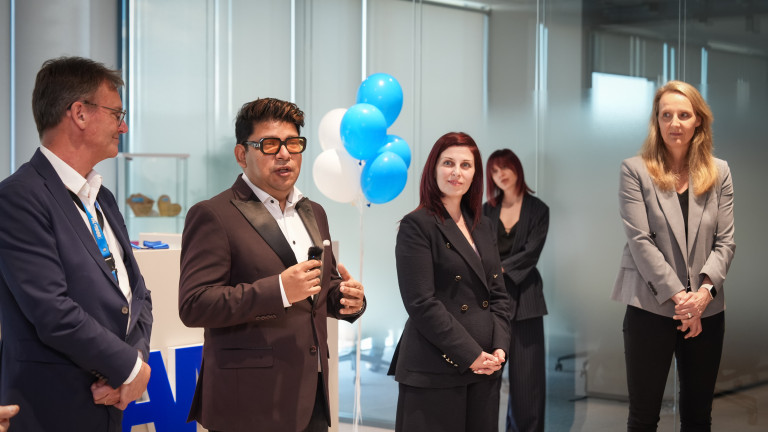
So far, I"ve seen that people in Bulgaria adapt very quickly. That"s why we"ve opened a new office and are investing here. Bulgaria is strategically important to our company. That"s why I"m extremely excited to be here - because of the talent I see, their mindset, their attitude, their motivation, and their curiosity.
If you have the skills, you can reinvent yourself in the age of artificial intelligence. That"s the key.
Is that the most important aspect of the new office in Sofia and of the business in Bulgaria as a whole?
It"s a technology hub for platforms - the team does critical work for many countries.
Today, the Bulgarian team plays a vital role in supporting the business. In the future, it will be the driving force behind the training of our AI processes and agents. When we become an AI-driven company, Sofia will train the algorithms and bots.
Some people who have never worked with AI are now creating AI agents - that"s impressive. The most important asset isn"t how much they know about AI, but whether they have the right mindset, curiosity, and insight.
What comes after artificial intelligence? What comes after what we now call the digitization of business?
The future lies in collaboration between people and agents. People will manage agents, agents will manage people, agents will manage agents. This is coming very soon.
We will see not just automation or chatbots, but the coordination of tasks and the linking of processes through agents. Every employee will have their own agents managing their workflows.

Източник: Ingram Micro
There will be companies with many agents and few employees. This will allow them to be more innovative, to focus on value and growth rather than on routine management.
Intelligence is the new operating system. Companies that embrace it and use it through orchestration, aggregation, and AI agents will win in the long run.
You"re talking about companies with many agents and few employees. There"s a well-known concept of so-called "dark factories," where there are practically no people and everything is done by robots. Do you think that in the future we"ll see... "dark offices"? Companies with no people in them.
It"s too bold to talk about "dark offices." In my opinion, companies will have both people and agents. People train the agents, and the agents train the people.
There may be "dark" warehouses, but not offices. The first chatbot was created in the 1960s, but people still have jobs. Ten years ago, we were talking about autonomous trucks, but drivers haven"t disappeared.
This is evolution. It"s not about people versus AI, but about the experience. People always find a way to work with new technologies.
AI is human intelligence at scale. A "dark office" doesn"t mean intelligence. Intelligence lies in connecting the dots, in orchestration.
By working with agents, people improve both them and themselves. That"s how I see the future - a better world where people and AI work together. We are a resilient species and have always adapted. We will adapt to AI as well.
















 USD
USD CHF
CHF GBP
GBP